Monday, March 21, 2011

A Tribute To My Father, 1919-2008

Dad passed away three years ago today. It was Good Friday (try to find a more fitting day for my father) and we were a part of the Passion Play that our church presents each year.  When we got home there was a message on the answering machine from my sister indicating that Dad had had a stroke and was not in good shape. 

By the time I got through to my sister, Dad had passed away.  It was a bit of a shock to say the least. He was 88 and living in a retirement home in Parry Sound.  He had gotten to the point of not being able to care for himself, in his own home, but was still enjoying fairly decent health, considering his age.

 The following is the eulogy that I wrote and delivered at his funeral.

 
George Newton Hosick,
May 22, 1919 – March 21, 2008


George Newton Hosick was born on May 22, 1919, eighth living child of John and Minnie Hosick. One of the childhood rituals that the family all talk about was the trip back and forth to school, a distance of three miles one way. In the winter when the lake was frozen, the children could ski across the lake which shortened their journey considerably.

George came to a strong faith at about the age of sixteen, and like every other facet of his life, he embraced this faith fervently and has so ever since. This faith made a decision very difficult a few years later. World War II called George to defend his country. His religious beliefs must have raged mightily with his patriotic feelings. I’m certain, torn in his spirit, he headed overseas. While there were emotional scars, Dad has born physical effects of the war since those awful days. The constant bombardment of artillery robbed him forever of a large portion of his hearing.

Dad was a member of the 19th Field Regiment Battery of the Royal Canadian Artillery, which supported the 3rd division. Dad was a bombadeer 105 mm r operating guns on landing craft tanks. He was there on the banks of Normandy on D. Typical of Dad’s self deprication was his reply “ I was no hero, but I wasn’t as scared as I thought I might be.”

The fall after Dad returned from overseas, he and Mom started seeing each other. This meant that Dad had to walk from his parent’s home in Dunchurch to the Patterson farm in Sunny Slope to see his sweetheart. Always a lover of flowers, he would carry an armful of gladioli for Dorothy. Within a month they were engaged and the following August 2nd, 1947, they were married at the Patterson farm.

George and Dorothy purchased the farm from her parents. For the first years of their marriage, they shipped cream from a small dairy herd. Also Dad raised sheep, beef cattle and operated a sizeable maple syrup enterprise.

Dad was offered a job with the Lands and Forest Department, planting trees. Because he was a good worker and conscientious, he became a foreman in charge of the Junior Rangers, among other endeavours. For several years Dad worked virtually full time off of the farm. However in the 1980’s, the ministry began cutbacks and work became scarcer and available only at greater and greater distances. An opportunity arose for a janitor at the Whitestone Lake Public School. For the last five or six years of his working life, he kept Whitestone Lake Central School spotless.


After selling the farm to their sons, Mom and Dad moved to Dunchurch in 1982. They remodeled the former Dunchurch Gospel Chapel that we attended for years. Retirement was kind to my parents. They enjoyed good health for many years and were able to take several trips with other seniors across the country and over to Europe. Dad had time to grow tremendous vegetable and flower gardens.

Retirement also gave Dad time for his other passion – fishing. He particularly enjoyed his snowmobile and his three wheeler which made him able to get to those far away secret lakes where the big ones lay waiting his arrival. Dad also liked to hunt. He enjoyed partridge, and duck hunting, as well as moose and deer. When he retired, he made several successful forays into the far north, with the younger set, hunting for moose. 
 
Dad was always extremely devout in his faith and the backbone of the Gospel Chapel. Dad’s faith spilled over into his everyday life. He read a chapter of the Bible three times daily, aloud to the family and every morning, would pray.

Mom and Dad were married 55 years. Theirs was a strong marriage and I know they truly loved each other. There are many love letters, which they exchanged during their brief courtship. Mom was working in Orillia, and Dad was working in the bush in Whitestone for Jim Stickland.

Dorothy passed away nearly five years ago on April 4th 2003, after a valiant battle with cancer. While George certainly missed his life-mate, he was able to carry on very well for several years, batching it, along with his son John, who came for supper most nights. He became quite adept at cooking and looking after himself.

George loved music He loved to sing though, and he knew numerous hymns off by heart, and often would entertain the nurses and caregivers with his impromptu renditions. Apparently he made that remark that he was practicing to be ready to sing with the angels. George loved to visit and talk with family, friends and neighbours. The front door was always a revolving one, with someone constantly dropping in for a chat or a meal, or just to see how he was doing.

George was never concerned with worldly possessions. He did love to fish and hunt, and was always of lovers of his flowers and vegetable patch, and he loved nothing better than a good home-cooked meal and an evening with friends. So what does he leave as a legacy: four children and four grandchildren, who loved him and a multitude of neighbours who called him friend. George will always be remembered for his wit, his laughter, his humility, his faith, his loyalty, his devotion, his love.


The spring before he died. Yes he caught all three pickerel himself.  He was so pleased.  My wife took this shot and I think she really captured the essense of Dad in it.

This is the last picture I have of Dad and I together.  It was taken at Christmas time before he died.  

Often if something interesting happens in life, I get that urge to go and telephone Dad and tell him about it, and then I remember that is no longer an option.  Dad was a good little man, and I will always miss him, but am thankful for the wonderful memories I have of him.

And that is about all I have to say for today.

Musings and meanderings from the Musical Gardener.

Sunday, March 20, 2011

Savannah, Your Typical Cat

You will note in my personal summary that I am the owner/slave to two very non talented cats.  And that is what they are - just cats.  Neither will ever aspire to the lofty heights of feline divinity that Tessie aquired.

A year and a half ago, we decided to get another cat to keep Whittaker company.  Whittaker is our thirteen year old neutered male.

We went to the pet shop, but they had no kittens.  However there was an ad on the bulletin board for free kittens - my kind of price.  So we took down the number and called when we got home.  The house was just a few miles away, so we immediately set off.

Well, they certainly had cats and kittens.  It was a pleasant fall day, and there were cats of all colours, sizes etc roaming around the porch.  The litter advertised was no less than six: four blacks and two tabbies.  Now we are a tabby cat family - nothing else will do.  If you are a cat person, you probably have your own specific traits too!

The runt of the litter definitely caught our attention.  First of all she was the required tabby, and she came bouncing over to see us.  Her pretty little tabby sister, was very elusive, not a trait we were looking for.

So home we came with Savannah.  The first order of the day was to get her properly photographed in her petite condition.  My wife and daughters seemed to feel a teacup was the proper receptacle, to get a sense of proportions.


Whittaker was considerably less than impressed.  Here he was preparing to live out his golden years in peace and tranquility (that translates into 23 hours per day on our bed, the other hour  devoted to eating, toiletries, and fastidious personal grooming).  However this dream was shattered with the bouncing, biting lump of cat aggression that we launched on the poor unsuspecting boy.


He has adjusted reasonably well, and she does try her best to keep him young.


Unfortunately, Savannah's early affectionate phase was somewhat short-lived.  She has become  very independent and pretty much aloof - typical cat natured, I suppose.  She is very friendly and affectionate if her food dish is empty, but as soon as the bowl is full, we humans quickly lose our appeal.  I guess it is a typical case of cupboard love - just so different from our sainted Tessie.

And that is about all I have to say for today.

Musings and meanderings from the Musical Gardener.

Saturday, March 19, 2011

Maple Meanderings

Oh what to write about today!  What a day it has been.  Usually I get up early and write post my blog before the day gets underway, but this morning I didn't.  And here it is 6:00 pm and I'm finally getting around to blogging.

We could talk about the weather.  It was an absolutely gorgeous spring day here.  There was actually a skiff of snow on the ground when we awoke this morning, but it melted off fairly quickly.  This afternoon is a very pleasant, +10 or so.  We went for a walk when we got home about 4:30.  There was quite a brisk north wind in our face, but is was beautiful coming back.  A neighbour has about 20 sap buckets hung on his maple trees.  I noted most of the buckets were a third to half full.  Now I'm not sure whether or not he gathered either yesterday or the day before.  He was not boiling down though.  I was looking forward to seeing smoke and steam billowing out of his little evaporator shed.

Every once and a while I get a nostalgic twig, and think it would be fun to have twenty taps, and a little evaporator, and then I remember how much unnecessary work it would make at one of the busiest seasons of the year.  I remember growing up in the maple industry.  Dad tapped as many as 1200 trees a year.  When I was about eight, he decided to go into it in a big way and invested in pipeline, a generator and a vacuum pump.  It all seemed good on paper, but mother nature had a lot of pitfalls in the plan.

Dad and Uncle Lloyd beside the sugar shack. Note the buckets, this must have been a year or two prior to the pipeline escapade.

Dad boiling down.  Note the fire in the doorway of the evaporator.

A neighbour, Frank Johnston, and Queenie, gathering sap, the traditional way.

Because the system was all on vacuum,  if you accidentally bored too deep and hit a hollow spot in the tree (it only takes one), it sucked air, rather than sap.  Dad spent countless hours tracing the lines, trying to determine where the hollow trees were, time that should have been spent boiling down.  Then there were squirrels, and raccoons that dearly loved to chew into the clear plastic tubing and grab a drink of sweet sap- again more holes to pull air.  The big feeder lines,one inch black plastic PVC pipe which were put up higher in the trees and left year round.  The problem here was that the bears like to climb the trees and chew on the plastic piping.  And more than once a moose tangled his massive antlers in the piping and pulled it halfway across the back forty.


This video show my brother loading up the neighbour's big new evaporator.

For all the syrup we use, I can easily buy a liter or two for the next fifty years, before I would ever get my investment back, just in equipment.  Oh yes and I forgot the fact that I don't have any maple trees on my property.

And that is about all I have to say for today.

Musings and meanderings from the Musical Gardener.

Friday, March 18, 2011

My Daughter and the Slaughter

Growing up on a farm made me rather callous to the butchering of animals for our winter food.  Each fall we fattened a cow that came in from pasture, open or not-in-calf.  Often it was an aged animal, but Dad always maintained that if they were thin enough to begin with, and you put the grain right to them, it was all new meat and thus a delicacy.  Well I'm not sure how accurate that all is, and I never remember having steaks or roast that you could cut with your fork.  In fact I was quite surprised when I first had a restaurant steak, how tender beef could be.

And then we usually raised a piglet or two for pork each year.  Dad would get a pair of weaner piglets, and they would live in the barn over the summer and fall until they reached the required weight.  This also meant, that although the cows were out to pasture for the summer, there were still barn chores to do each day and a pig pen to muck out.  I really hated killing the pigs, not that I ever had any great sentimental attachment to them -- I hated the smell of them being dunked in scalding water and scraping the bristles off.  It was just that 'pig' smell amplified by the heat and steam.  

Mom always made head cheese from the pig's head.  It is funny I liked head cheese as a wee lad, until I actually watched and comprehended the process of production.  You simply put the head in a huge roasting pan and boiled it for several hours until the meat fell off the bones. Then Mom would sort through, get all the fleshy parts, all the juice and put it in pans to congeal.  I think it was seeing the teeth (pigs have really horrible brown tartary teeth) and eyes etc, still intact, on the picked over skull, realizing that the juices off of them, were an integral part of homemade headcheese.  Folks raved about Mom's headcheese for miles around; I still harbour thoughts of becoming a vegetarian forty years later!

Then there were the chickens.  Usually we would buy about 50 day old meat birds at the local feed store and rear them over the summer.  Mom and I then tackled them in groups of ten or fifteen per day, scalding, picking, gutting and getting ready for the freezer.

Yours truly, looking too cherubic for words.  If you look in the box you will see a rooster's feet and tail feathers.  At the back are my brother and my aunt in front of the Christmas tree.  Obviously this rooster is about to become Christmas dinner.  I would hazard to guess the date of this photo is exactly December 24, 1963.

I do recall one summer, the local feed man had a deal for all the neighbours.  He was giving away day old cockerel chicks -- for free.  Most of us all got 50 or better and then proceeded to buy feed all summer to grow out these little freebies.  The problem is free is just that, not worth much. These were little leghorn roosters.  No matter how much feed you poured into them, they never put an ounce of meat on.  They just grew long and lanky with a couple of tiny, tough strands of meat attached to their sharp pointy little breast bones. Mom always maintained that this particular salesman, could have "sold freezers to the Eskimoes."

By that point in time I was old enough and experienced enough to butcher the chickens, solo.  And that is what I did.  Mom and Dad were away for the day, and when they returned there were 50 carcasses cleaned and ready for winter, such as they were.  I have a feeling that if my parents had been helping they might have given up after the first ten, realizing just how little meat was there for all our efforts.  But we ate leghorn rooster all winter.  I know Mom had to roast them up in pairs, to get enough meat to feed our family of four, and then it was tough and not plentiful.  It was a memorable, if not particularly good chicken year.
For a few years my wife and I raised our own meat birds, buying day old meat birds.  These creatures can hardly be called chickens.  They more resemble reptilian grain processing machines.  They basically eat and poop for eight short weeks, and then either their legs or hearts give out.  The trick is to kill them, just before either happens.  We did learn that pullets, as opposed to cockerels were a slightly better bet, longevity-wise.  We could even keep them up to ten or twelve weeks and the corresponding ten pound weight, if we were careful.

When we got into laying hens again, we had several broody ladies and we let them hatch their own babies.  Of course about half of these would end up being boys.  Unfortunately, because these were laying hens with laying hen genetics, these fellows were reminiscent of the leghorn lads of my childhood - not much meat for the food they consumed.

My eldest daughter, ever the one to tackle new ventures, volunteered to help me butcher one of these batches of roosters.  Her mother was there with the camera to capture it all for posterity.  And we've used the experience to our advantage several times.  Whenever she encounters something particularly unpleasant, we can usually goad her on, "Come on, you've gutted a chicken, you can handle anything."

And that is about all I have to say for today.

Musings and meanderings from the Musical Gardener.


A good outdoor job - not near as much clean up after.

Thursday, March 17, 2011

My Irish Roots

My great, great grandparents emigrated from Ireland about 1853, although the records I have suggest it could have been even earlier.  With the potato famine devastating Ireland from 1845 - 1850, I would wonder if this may not be the case.  Great, great Grandpa James was born in 1802 in County Monaghan, Ireland.  He married Sarah Fox (there is some debate about whether that is the correct surname or not), who was born in 1802 (or 1814, which ever record you follow), in Ulster, Ireland. 

Records suggest that they had six children, when they emigrated originally to the USA.  My great grandfather, James II, was the youngest of these children to cross the ocean. There may have been two children who died in infancy in Ireland - again the records are sketchy at best.  Four more children were born to the couple after they arrived in North America.

After coming to the USA, they eventually ended up moving to Caledon, Ontario, eventually farming in Amaranth Township, Concession 5, Lot 5.  In 1975, my mother, and my Aunt Vera and I went for a road trip to Caledon.  We actually saw the original homesteading house.  Unfortunately it was slated to be torn down that same fall.


Wednesday, March 16, 2011

The First Transplants of 2011

You will remember I blogged a few weeks back on planting my wave petunia and tomato seeds.  Then a week later I showed you the resulting but very spindly little seedlings.  Well the time has arrived where they have outgrown their little 288 homes and need to be transplanted into 4 packs, 12 to a tray.

And that is precisely what I did yesterday afternoon.  It was a glorious spring-like day.  The greenhouse was hot, and pleasant for working in.  I took my three trays of seedlings from their basement abode, transplanted them into new trays and then took the whole works back to the basement for another few weeks, until the weather warms enough to not have frost in the greenhouse at night.

The greenhouse was kind of a mucky mess, as the snow is melting on the slope behind it and draining directly into it.  Also, because daytime temperatures have been elevated in the greenhouse most of the winter, the frost is out of the ground inside already.  But it was so nice just to be able to slop around in shoes and a sweatshire, and enjoy spring weather, outdoors (well in an indoor sort of way!). 


These are two of the 288 flats with their very well grown little seedlings, ready to move to new homes.  Note in photo one there is a large gap - a variety of wave petunia with no germination at all.

In the photo to the left, note the very straggly, leggy tomatoes as the bottom.  Never fear these will be sturdy little plants in a few short weeks.


Getting ready.  New tray, 4 packs, and a pail of soil-less potting mix
4 packs filled with potting mix, ready to receive little plants

Here is a tray freshly transplanted and gently watered.  I will put the clear cover back on for a few days, just to keep the moisture level up.  No matter how careful you are with the plant plugs they need a lot of moisture, to recover from the transplanting trauma.


Everybody is back in their basement home for the next few weeks.  You will note that three 288 trays expanded into 9 trays of 48's (don't do the math, there were a lot of no shows during germination).  I also planted two more trays (with covers) - more petunias (tidal waves) and tomatoes, parsley, and a few other annuals.

The next venture is to start slipping the plants that I kept over winter.  But that is another whole blog in itself.

And that is about all I have to say for today.

Musings and meanderings from the Musical Gardener.

Tuesday, March 15, 2011

Our Walk, First Day of March Break

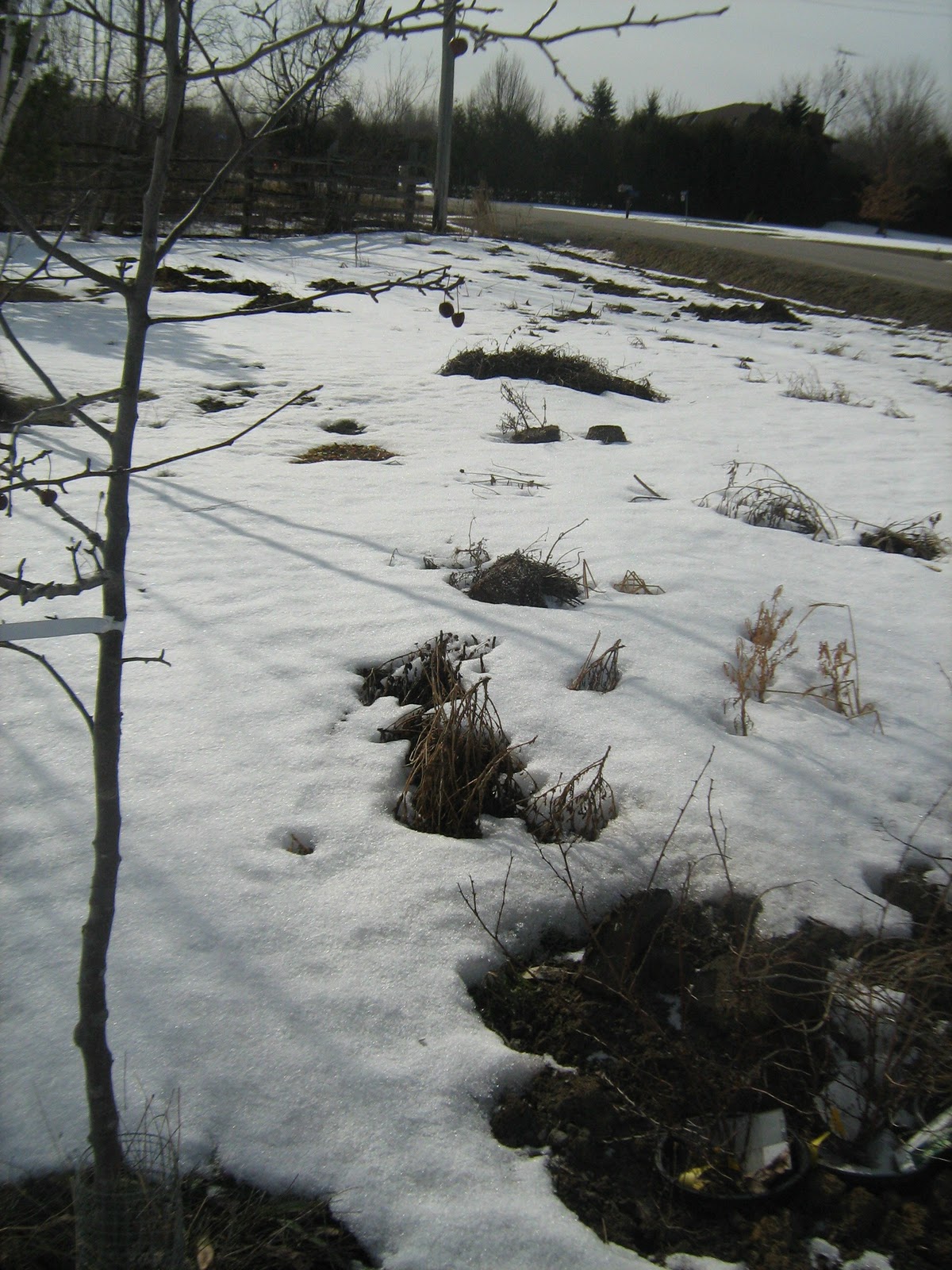
We went for a wonderful spring walk yesterday.  Well spring may still be pushing the season, as you will see by the remaining snow.  Here are some of the sights we get to enjoy on a daily basis.  I love living in the country. We get to enjoy such beauty, minus the hustle and bustle of the city.

Dormant flower bed - imagine tulips!
My vegetable garden - not quite ready to work yet
Two very pretty little ladies

A survivor
A mighty oak - the kind you would build a house under
A neighbour's Muscovy ducks sunning
Spring run-off
A knotty situation
The circle of life
Do I need to make any commentary?  I think not, a picture is definitely worth a thousand words in each of these cases.

And that is about all I have to say for today.

Musings and meanderings from the Musical Gardener.